How Clinical Research Works From Lab Idea to Patient Care
- February 07, 2024· Article by Maria Jones
- Medicine , medical research
Every treatment we take for granted began as a question in a laboratory. Medical research is the long, careful process that turns a promising idea into something doctors can use with confidence. For most people, that journey remains invisible, which makes news about trials and breakthroughs hard to judge.
This article explains in plain language how medical research works, from first discovery to patient care. It is general education and not medical advice.
It starts with a question
Research begins when scientists notice a problem: a disease that is poorly understood, a treatment with side effects or a group of patients with few options. They study existing evidence and form a hypothesis, a testable idea about what might help.
Good research starts with a precise question, not a hoped-for answer.
Funding bodies, universities and research centers review such proposals, since time, money and patient safety are limited.
Laboratory and early studies
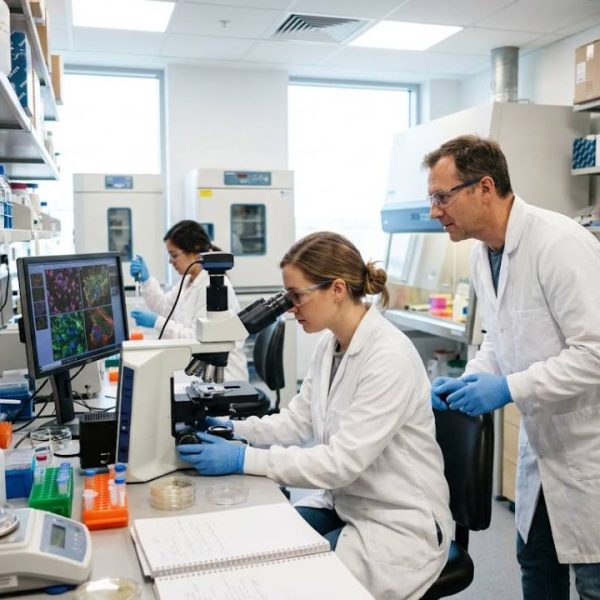
In the lab, researchers test ideas on cells, tissues and computer models. These early studies show whether a substance or method is promising, how it works and what risks may appear.
Some studies use animal models under strict ethical rules, because regulators require evidence of safety before testing in people.
Most ideas never move beyond this stage. That is normal, and it protects patients from unproven approaches.
The phases of clinical trials
Clinical trials test treatments in people, step by step. Phase one involves a small group and looks mainly at safety and dosage. Phase two studies a larger group to see whether the treatment seems to work. Phase three compares it with the current standard or a placebo in many participants.
After approval, phase four monitors long-term safety in everyday use, because rare effects only appear when thousands of people are treated.
The World Health Organization publishes guidance on research ethics and clinical trial registration worldwide.
Protecting participants
Ethics committees review every study before it starts. Participants must give informed consent, which means they understand the purpose, risks and their right to leave at any time.
Independent monitoring boards watch the data during a trial and can stop it early if a treatment proves harmful or clearly effective.
How results become evidence
A single study rarely settles a question. Researchers publish results in scientific journals, where other experts review the methods and conclusions. Other teams try to repeat the findings.
Systematic reviews combine many studies to give a stronger picture. When several well-designed trials agree, guidelines may change.
Regulators and approval
Before a medicine is sold, regulators examine the full data on quality, safety and effectiveness. They may approve it with conditions, request more studies or refuse approval.
Approval does not end oversight. Safety reports from doctors and patients continue to be collected and reviewed.
Research across languages and borders
Modern studies often run in several countries at once. Consent forms, patient information, protocols and safety reports must be understood by every participant and regulator involved.
Accurate wording protects people. Research teams commonly rely on specialist medical translation services to keep terminology precise and documents consistent across languages.
This article on the importance of medical document translation explains why even small errors can have serious consequences.
How to read health news critically
Ask who ran the study, how many people took part, whether there was a comparison group and whether results were published after expert review. A study in mice or cells is an early step, not proof of a cure.
Be cautious about headlines that use words like miracle or breakthrough. Reliable reports mention limits and the need for further research.
Why patient involvement matters
Patients and carers increasingly help shape research by suggesting questions, reviewing materials and sharing experiences. Their input makes studies more relevant and easier to take part in.
Clear, respectful communication builds trust, which in turn improves recruitment and results.
Data, privacy and consent
Research relies on health data, and protecting it is a core duty. Data is usually coded or anonymised, access is limited to authorised staff and rules such as data protection laws set clear limits on use and storage.
Participants should always know how their information will be used, who will see it and how long it will be kept. Clear explanations help people make confident choices.
Trust is the foundation of research: without it, no one volunteers, and without volunteers there is no progress.
Rare diseases and unmet needs
Diseases that affect few people are often neglected, because trials are harder to run and markets are small. Research centers, patient groups and public funders increasingly cooperate to share data and design smaller, smarter studies.
International networks help find enough participants across countries, which again depends on clear, accurate communication in many languages.
What to remember
Medical research is slow because it must be safe. Each stage, from lab to trial to approval, filters out weak ideas and strengthens good ones. If you are curious about taking part in a study, speak with your own healthcare professional, who can explain what is appropriate for your situation.